Saturday, August 31, 2024

A New Frontier: Building bots without code!!!

 Dear Readers, 


Welcome back to this month's Chronicles of a Neurodivergent Programmer.  Last month, I took a break from writing about tech and instead shared by thoughts about a type of imposter syndrome surrounding my identity as a disabled person.  This time, I would like to share a recent experience building bots without a single line of code!  


Up until now, I've had experience using ChatGPT models using the chat interface, created bots using prompt engineering using the Python programmatic interface, and trained my own LLM models using open-source models.  Continuing on in my LLM journey, I was given the opportunity to use an open-source LLM app building platform that allows users to make their own chatbots.  For previous posts related to LLM have a look at the list below:


In this revolutionary platform, the simplest bots could be built with just prompt engineering.  Let's say that you want to build a summarizing bot.  Just write a prompt that reads "You are an expert at summarizing long pieces of text.  You will be given a piece of text, so please answer the summary."  And... that's it!!! Congratulations, you built a bot that can summarize text!  


If you want to make a more complicated bot... you still might not need to write a line of code!  There was an additional option to create your own custom bot using a simple drag-and-drop method.  You're provided with several types of blocks that each serve their own function.  Combine the different blocks you need in a sequence, and you should be able to build the bot you want.  For example, if you want to build that only summarises text written in English but not recognize any other language, you can add a divider that can recognize whether the text was written in English or not.  If the text was in English, then create a summary, but if the text was in.... let's say Spanish, then return a message saying "Sorry, I only know English."  


There are a few other features, including add-ons and writing a few lines of code for detailed specifications, but still this platform makes it much easier for everyone to build their own bots irrespective of their knowledge of LLMs or tech.  


Call me old, but I still remember the time the movie "I. Robot." came out.  There was a very "human" robot existing among other non-sentient robots with an antagonist that was introduced as a very intelligent AI.  With the rise of awareness about generative AI, perhaps we're finally heading to a transitional phase in which mankind is becoming less fearful and more accepting of the existance of AI in society.  As such there may be a growing demand for simple AI-based bots to be accessible to the general population.  


I look forward to venturing further into the realm of generative AI as well as data science in general to see what the future beholds.  I certainly had fun playing speed typing games and learning how to code my first "Hello World."  Hopefully there will be a lot of people in the future that will be able to enjoy the fun world of tech!!!


Sincerely,


Lukas Fleur


P.S. If you're interested in me showcasing this platform on this blog, let me know in the comments below!  

Monday, July 15, 2024

"Am I disabled enough?" A neverending thought

 Hi!  

Have you enjoyed my latest post where I attempted to apply basic LLM concepts to summarize, paraphrase and translate a block of text?  

See LLM Project 1: Translating, Summarizing, and Paraphrasing (using T5)


I'm going on a summer break soon so I thought I'd take a bit of a break from coding and generative AI and focus on a topic related to neurodiversity!  This time, I'm going to share my thoughts on my personal experience going back and forth wondering whether I'd be... disabled enough to call myself disabled?  If you're interested in the discussion about whether autism is a disability check out a previous post:  Is autism a disability?


I was inspired by a YouTube video by Jessica Kellgren-Fozard (Am I disabled enough ft. Hannah Witton) and their experiences with that same dilemma.  It seems that it's a very common sentiment and I've also met people in my own life that share that same feeling about themselves.


When it comes to myself... I feel conflicted.  Mainly because on one hand I am able to live an independent life for the most part.  I live on my own while renting my own property, have a full-time job, and I do have close friends and family.  In my every day life, I don't particularly feel like there's a noticeable difference between my life and other presumably neurotypical and/or able-bodied acquaintances.  


However recently I took an exam that affects my future career prospects.  Back when I was in the middle of booking this exam, I was going through the website for information about accessing reasonable accommodations... and they didn't offer the exact accommodation that I needed which was extra time in exams.  When I was first diagnosed as having specific learning difficulties, the psychologist stated that extra time WILL BE REQUIRED in any written exams so the exam provider strictly prohibiting the request of extra time in exams... made me nervous. 😰  (If you want to read more about specific learning difficulties, check out: Unravelling the mystery of specific learning difficulties) Still me passing this exam is a requirement for future promotions, so I scrolled through any other accommodations that the exam provider offered and decided to request the use of ear defenders during the exam so I won't get distracted with people going in and out of the exam room (I suppose this is an example of auditory processing difficulties).  In the end I did manage to book the exam with the use of ear defenders approved and thankfully the exam venue was close to where I live (unfortuately not all exam venues allow the use of ear defenders even if the exam provider approves of it).  I also managed to pass this exam and got a bit of a celebratory allowance from the company I work at, so all's well that ends well!


While I do have to take exams occassionally, it's not nearly as an all-encompassing existance as it used to be compared to my student years.  However I do still experience struggles with specific activities of daily living, most notably shopping, holding a conversation in public spaces (especially with multiple people or in loud spaces), and not being good at consistently make and maintain relationships.  Shopping is diffcult due to an uncomfortable sensory experience that can lead me to have meltdowns (or more accurately shutdowns) if I don't take frequent breaks in between shops.  I struggle to follow a conversation with multiple people since I lose track of the topic, and zone out in the middle of long conversations.  I just sort nod along and respond as little as possible, engaging in my surroundings (or food if it's during a meal) instead.  When it comes to relationships, I do have people I'm close with but most of my friends and family live far away and consistently being active on social media has never been my strong suit so I need to have a rigid schedule to keep in touch with them and if it doesn't work, I'll just lose touch.  


The above instances reminded me that the world is not very accessible and that there is definitely a component of our temperament relative to the rest of society disabling us regardless of whether the condition itself is life-threatening.  It could also be noted that anyone that doesn't identify or suspect themselves as having a disability would rarely, if ever, even think about what can be considered a lack of consideration.  


I remember a conversation I had regarding neurodiversity (although I didn't "come out" at this point) and someone mentioned that they could be neurodivergent but is afraid to be looked down on because of it.  As a response, another person said "it's fine to be a bit quirky if you're not a bother to anyone."  This phrase may have been meant as a reassurance but I personally found it an ableist and honestly offensive response.  Sure I don't recommend intentionally going out of your way to bother other people but the fact that this person said being a bother to other people is the  line between a "quirk" and a disability bothered me.  Surely the line would be whether the person is living a reasonably healthy life, or at least can have opportunities for a good quality of life?  This phrase made me realize the repercussions of an ableist society that 1) judges disabled people by how "able" they appear 2) whether they are a burden on the people around them (and perhaps society as a whole) without considering the wellbeing of disabled people themselves as if they are not a part of the larger human society.  This also disturbed me since disabled people can be considered the largest minority community that ANYONE can be a part of at any given time so discussions about accessibility benefit EVERYONE not just people who are currently disabled.  


Me reflecting on this conversation and thinking about how ableism seeps into the average person reminded me that I'm very much part of the disabled community since anyone that has never considered the possibility of being disabled themselves probably wouldn't even think of this.


Even after all this I still go back and forth in my identity as being disabled because... I can still more-or-less... function without much support, but the fact I still need what's considered to be "special" support in certain situations... means I'm disabled?


How did you all feel about this post?  It may have been a bit ramblier than usual but I hope it gives an additional perspective about the question "Am I disabled enough?"  Please, comment down below because I would love to read your thoughts!

Saturday, June 29, 2024

LLM Project 1: Translating, Summarizing, and Paraphrasing (using T5)

Enjoying the LLM journey so far?


I've been introducing LLM concepts so that you can understand what some terms mean and how they appear as code outputs.  This is a reflective post about concepts covered in the previous chapters, namely tokenization, encoding, and decoding.  Don't remember what these words mean?  Have a look at the posts below:

As promised in the last post, this time we'll be looking at how to actually USE T5 models to do the following tasks: translation, summarization, and paraphrasing.  
For future reference, generating answers using LLM models is called "inference."

Have a look at the Python code below!  


You'll be able to see how one can:
  1. Import the model
  2. Execute a query
  3. See the output the model generates
  4. See which tasks the model can perform best.

I'm in the mood for trying something new for a change, so here's a quiz based on the code above.  Read the following questions and comment down below!
Q1:  What was the name of the model that I used?
Q2:  What were the tasks that I had the model perform?
Q3:  Which task did the model perform best at?

Ending

Hi everyone!

Are you enjoying the series so far?  I've actually found all of this to be fun to present.  ChatGPT can be useful and entertaining but I started to enjoy them even more once I started using and training my own models.  It doesn't always work in the way that I want it to... but I guess that's part of what makes them interesting to work with.  🀣

Since it's now halfway through 2024, I'm thinking of sharing a post about neurodiversity next month.  Still considering what to write about but I'll let you know when I'm comfortable sharing it. πŸ‘Š


Sunday, May 19, 2024

LLM Part 3: Decoding

Tada!  Here's Part 3 of the large language model series!

Are you excited for the next chapter of our LLM 101 series?  So far we've covered tokenization and encoding.  If you need a refresher, have a look at the pages below.
  1. LLM Part 1: Tokenization
  2. LLM Part 2: Encoding
In short, we've learnt how to break down pieces of text and assign a number to each piece.  This ensures that the model will "know" what your question is going to be.  But how do these models answer back in a way humans would understand?  This is where the concept of decoding is important.

If encoding is to turn text into numbers, decoding is the reverse: to turn numbers into text.  Here's a PDF of a Jupyter Notebook which allows us to revise the previous concepts as well as show what decoding looks like in code.


Now that you've had a look at the PDF, we've now covered tokenization (breaking down text to pieces), encoding (converting pieces of text to numbers), and decoding (converting numbers back to text).  

You should now be able to:
  • Type a text-based input into the model
  • Retrieve text back from the model

I know it doesn't sound like you're doing much at the moment but nailing these concepts will help you build and use LLMs in the long run.  Next time, we'll be asking the model to perform simple tasks using Python.  Namely, summarization, paraphrasing, and translation.

Ending

How have you found the LLM series so far?  Hopefully it's been helpful in understanding these basic concepts.  I remember being pretty lost when I first started studying about LLMs, so I'm aiming to make LLM studies more accessible for all!!! It may be easier to use ChatGPT to generate answers (especially since some of the earlier versions are available for free now) but I found that being able to use LLM using code is very satisfying. πŸ’ͺ

Monday, April 29, 2024

LLM Part 2: Encoding

Welcome to Part 2 of building your own large language model!

Part 1 was about breaking down your input text into smaller subwords. (tokenization)  If you don't remember what subwords are, have a look at the post below:

LLM Part 1: Tokenization

(If this post still doesn't make the concept of subwords very clear, please leave a comment below!  I'll try and make another post to elaborate further.)


This time we will be covering encoding: the process of converting subwords into a list of numbers called "token IDs."  Machines are good at processing numbers so encoding enables the machine to "know" what pieces of text are being fed into it.  However, it is important to note that encoding is NOT about understanding the context of the input.  (That will be covered in a future article.)  Instead it's simply about recognizing the subwords in the input.


Here is a Jupyter Notebook for you all to revise tokenization, and then show you how you can encode those subwords.  I've also added an alternative line of code that can tokenize and encode the input at the same time!

LLM Part 2: Encoding


To summarize:

  • Tokenization:  The process of breaking down the input text as a list of subwords
  • Encoding:  The process of converting the subwords into a list of token IDs
Step-by-step illustration of tokenization and encoding using example text from code.


Ending

How did you find this post?  It may be short but I hope it makes these concepts easier to digest.  Personally I struggled to know where to begin when studying LLM concepts myself when I first started out, so I wanted to explain these as simply as possible.😊  Next time we'll be covering another key process called "decoding."  Then we can finally make LLMs perform simple tasks using a few lines of code!  Stay tuned for future posts.😎

Update (2024/05/19)

The next part of the LLM series is out now!


Friday, March 1, 2024

LLM Part 1: Tokenization

 Hi everyone!


As promised, I will present a tutorial on how to build your very own large language model!  This part focuses on tokenization.

What is tokenization?

It's the process of converting human text into a sequence of numerical IDs that LLMs can understand.  A similar idea among humans is word-by-word translation of individual words from one language to another.  

For example, a word-by-word translation of "I love you." into Japanese can become "私(I)ζ„›(love but this word is in noun-form)君(you)."

(Important: Not including context or meaning at all)

Tokenization is a necessary first step because how would a model do what you want if it doesn't even know what words you're saying!

How does tokenization work?

  1. Prepare text
  2. Break down text into smaller chucks of text:  These can be as following
    1. Words
    2. Alphabets
    3. Sub-words (Common letter combinations in words) - Most common pattern
  3. Convert chunks into numbers called token IDs
That's it!  Tokenization is all about creating a series of token IDs from breaking down your text into smaller chunks.

To get a better understanding, I prepared a mini-project tokenizing and de-tokenization the text "Hi! I'm Lukas Fleur.  Nice to meet you."


Ending

How did you find this first part?  When I was reading about tokenization for the first time, I felt like I had to read around in circles to get a good understanding of it.  Of course, if you want to have more in-depth knowledge there are more resources out there, but this is a good first step in understanding tokenization, and thus LLMs.

For now, we'll be focusing on building our own T5-model but we can revisit the topic of tokenization in the future to see what we can do using this technique!

How did you find this article?  If you enjoyed it, or hated it, comment down below!

Update

I recently re-read this page and I realized that I was actually confused about tokenization and encoding myself!  Apparently, tokenization is simply about breaking down text into smaller units, but the assignment of a token ID per token is actually encoding. (I was confused because of the name token ID haha... πŸ˜…)  I've stricken out the bits that were actually to do with encoding, and updated the code in the link to only showcase tokenization.

I'm so sorry if I've caused any confusion!  I am currently working on the next article which will be titled "LLM Part 2: Encoding" where I will expand on what encoding actually is.  Stay tuned! πŸ‘€

Update(2024/05/12)

Here's the next part of the LLM series:

Resources


Saturday, January 27, 2024

Introduction: What are Large Language Models?

Happy New Year!

Welcome back!

At the end of 2023, I started mentioning ChatGPT.  

Merry Christimas! ... Also my thoughts about GPT

To show what makes GPT models so special, it would be interesting to give a basic introduction to large language models (LLMs) in general, focusing on building simple LLMs using T5 models.

You may be wondering "What is LLM?", "What are T5 models?", "You talked about GPT last month, so why use T5 models instead?"

What is LLM?

LLM refers to a type of AI that can generate text-based answers.  ChatGPT uses GPT models which are a type of LLM.  You have your LLM, you ask it a question, and it gives you back an answer in text.  

What are T5-models?

T5 models are another type of LLM.  

You talked about GPT last month, so why use T5 models instead?

  • Intuitively easier to understand LLM concepts:  I'll write about this in more details in future blog posts, but building T5 models require a basic understanding to how LLM reads, understands, and generates human text.  T5 models are SUPER easy to build so you can have the satisfaction of building your own AI while also learning how they work at the same time!  GPT models are very easy to use but most of how the LLM generates text isn't made apparent.  (GPT models are really cool in this aspect but more on this in the future.)
  • Cost: OpenAI gives an initial $5 credit to use OpenAI models, including GPT models, but after that's spent we have to pay to use them.  T5 models are completely free to build!  
  • Simple coding:  Basic T5 models only require a few lines of code!  

Starting next month, I'll be introducing key concepts related to how LLMs generate text:
Don't know what these mean?  Stay tuned!  On February, we're going to be learning "tokenization."  Get ready to build your own LLM!

Have any questions?  Any requests?  Do you just want to chat?  Comment down below!


Sunday, December 24, 2023

Merry Christimas! ... Also my thoughts about GPT

Merry Christmas and may you all have a Happy New Year!!!

As I'm starting my end-of-year vacation, I wanted to address my readers about how I'm planning to continue my blog in the future.  As much as I enjoy writing for you all, I realized that I prefer being spontaneous with my blog posts since I live a fairly structured life outside of blogging.  Instead of racking my brain with a new topic to write about every month, and getting stressed because I couldn't stick to my schedule, I'm going to continue taking a loose approach to writing.  

If you're not already aware, I work as a data scientist building and researching machine learning models applicable for improving existing services or developing new solutions.  I'm currently working on GPT models, including the latest GPT4, so I figured I could write how I feel about GPT for today and the foreseeable future.

In terms of asking GPT to perform a certain task in general, I believe that GPT is a very useful tool to help structure your writing, provide rough translations, or produce reasonable summaries, or really any task involving the written language.  However, I do believe that objectively testing how accurate the information is and how well GPT adheres to specific additional restrictions remains a difficult issue that will be a central research topic.  I enjoy the flexibility of being able to utilise prompting methods more flexibly using the programmatic interface rather than ChatGPT or Playground.  Due to the boom of ChatGPT, as well as other AI tools, I figured that you be interested in reading about such tools from someone that is currently paid to research and refine them πŸ‘€ 

Hopefully you will look forward to future posts... when they come out XD  
How do you feel about ChatGPT?  Do you find it to be a useful and innovative tool to solve your problems or improve your work?  Let me know in the comments below!

Again, Merry Christmas and have a lovely New Year! 


Thursday, November 23, 2023

Autistic in Tech: The Good, the Ugly, and the Ableism

LUKAS HAS RETURNED 

Hi everyone!

I know it's been a ridiculously LONG time since my last post, but working full-time and balancing other work and life-related activities has made my life pretty hectic πŸ˜…

Last time I wrote about my experience in going through interviews for job hunting.  Now that I've been at the office for a few months now, I figured that it's time for an update.  

It is a sort of stereotype to imagine autistic people working in tech, but do I feel like tech is actually a good place to work for autistic people in real life?  

Note: These are my own experiences and opinions, and not a full featured research study.  If you have any experiences of your own that you'd like to share, comment below!

The Good

Flexible working environment

Clothes, working hours, days off... Tech can be really flexible which is important for autistic people that have diverse needs.  I could wear anything from a suit to a hoodie at work, although it seems like I can't wear jeans to work for being "too casual."  I knew someone that wore sunglasses at work because of sensory sensitivity issues, and while some may have found it odd, this person seemed happy since they could continue doing so.  When it comes to working hours, while there are core hours I have to adhere to, beyond that I can clock in and clock out whenever I want as long as I attend mandatory meetings.  If there's any sort of technology I want or need to use, I can ask someone from the company for permission and it's usually possible.

Diverse personalities and interests

My workplace seems to take great pride in welcoming many types of people.  While I do think that in part, this can be some kind of corporate rhetoric to "encourage diversity," at the very least I feel like there's little urgency for conformity when it comes to how I think or what I like.  Everyone has their own interests and contribute some thought during discussions.  Hanging out with other colleagues (e.g. drinking parties) isn't mandatory unless on special occassions but you can go out if you want to.

Office and Remote working

Somewhat related to the flexible working environment, due to the pandemic, there's a more prevalent infrastructure for remote working.  Tech-related tasks can usually be done at both the office and at home.  It's possible to go to the office everyday, and it's also possible to work from home most of the time.  It really depends on the individual's circumstances.  

Investment in physical and mental health

Tech jobs practically force employees to sit in front of a computer screen for hours and hours.  This makes the person more susceptible to poor posture, less exercise, and poor sleep.  Perhaps this is the reason why my company takes great measures to give employees a chance to maintain their health by hiring HR staff that specializes in mental health in the workplace and having healthcare plans specifically catered toward the IT industry.  I find that this is beneficial for everyone, but since autistic people are said to have a higher tendency to have health issues compared to other populations, this can be especially important to consider.

Good salary 

Jobs in tech companies tend to offer fairly decent to great salaries.  I don't personally recommend finding your dream job with the money alone, but it is something to consider.

The Ugly

Long screen time 

It really is part of the job description.  You sit in front of a computer and work on finding solutions through coding, preparing presentations, and attending meetings.  At the company where I work, almost everything I do involves the computer.  It becomes difficult to make sure to take care of your eyes and make sure to take regular breaks to avoid health issues in the future.

Male-dominated field 

Maybe in certain parts of tech, there are more women who are actively involved in tech positions.  While there are some women who have held successful careers, I've noticed an overall lack of female tech workers in my company with less than 10% of tech positions in my company held by women!  I do believe that my company tries to be female-friendly as best as they can, and the gender ratio doesn't really affect my day-to-day life.  However, there have been instances where I the women in my company have to do certain types of jobs more than our male counterparts.  It's most noticeable when the company attempts to recruit new workers, and especially if at least one of the recruits is female, and the HR department prefers having a female tech employee to emphasize how female-friendly the company is.  Although at least in my experience, the women where I work at are fairly close.

Social interactions continue to be tricky

Apparently there's a stereotype that there's a lot of autistic people in tech.  While certain autistic traits are more-or-less acceptable in the tech space, there are many employees with varying backgrounds.  With different backgrounds comes different opinions and ideologies and sometimes these can clash.  Unfortunately, "reading the room" and following social norms continues to be a requirement for maintaining a peaceful work environment.  

The Ableism

Disability shouldn't be a "dirty word,"...  but it is (?)

It's interesting to me that certain autistic traits are accepted, especially the ability to have a sharp focus and deep interest in the topic, but disability conversations are not as commonplace as what I've been used to in university where we had a disability student society as well as a disability support centre.  Sometimes I wish we could have more meaningful conversations about health and accessibility since I've felt health and safety meetings are treated as a chore.

What counts as "reasonable" accommodations?

When I was in university, there was a disability support centre where they had a website with a list of disabilities and some example accommodations.  Each student was also assigned a tutor to help navigate reasonable accommodations.  In the workplace though, it's HR that investigates anything to do with employee welfare.  The company also doesn't have an open policy about disability besides revealing that there is an insurance plan in case someone becomes disabled due to the job.  Thankfully my workplace is fairly flexible in terms of working hours and I can request adding extra functions to my office computer, but I still believe that information about disability support can be made more widely available for the public eye.

The lack of disability-related education in some people can be... astounding...

Once, there was someone that gave a talk saying that "a disabled person won't be able to do the job."  Needless to say I was dumbfounded when I heard this but it also enlightened me that some people have never thought about disability and disabled people's potential in the workplace.  

Thanks for reading!!!

This post has taken me wayyyyyyy to long to write!!!  Thanks for reading until the end.  I hope you enjoyed it, and please feel free to leave any comments about the topic.  How do you feel about being autistic in tech?  Do you have different experiences and opinions?

I honestly have no idea when I'll be writing next but till next time!  Have a great life!


Monday, February 27, 2023

Autistic person talks about job interviews

Hi everyone!

Earlier this month on Twitter, I asked my fellow Autistics people there what part of job hunting they found difficult.  The majority voted for "Interviews", so for this month, I'd like to share my experiences in interviews.  Hopefully you can find some solace or enlightenment from this post 😊


Content:

  1. An overview of the job application process
  2. Why do we need to have interviews anyway?
  3. Types of interviews
  4. When did I feel like the interview went well?
  5. When did I feel like the interview went... not-so-well?
  6. Did my feeling and the results match?
  7. My overall thoughts on interviews
  8. Dear fellow autistic people 
  9. Final thoughts

An overview of the job application process


Interviewing is a common method of trying to find "the one" potential employee but it's still usually just one part of the job application process.  In most of the companies that I applied for, the application usually consisted of the following stages.

1) Preparing/Submitting application forms (CV, resume, portfolio, other documents)
2) Aptitute test (usually testing basic literacy, numeracy,  and "logical thinking")
3) Interviews (usually 2-3 rounds but it is possible to have more or less)
4) Offer (Hopefully 🀞)

There can also be take-home assignments, assessment centres, casual meetings with human resources (HR) or other employees depending on how competitive the role is and how much the company wants to assess "cultural fit." 

What does cultural fit mean?  Essentially it means that the person's presentation and core values align with the vision and values of the company.  The point of finding people who are a good cultural fit seems to stem from the idea that the company would have the manpower to realize their business plans and create their version of the ideal workplace, and keep their employees happy and keep working for the company.  (Sources:  Business News Daily, BBC) 

Due to the pandemic, most of the job application process (or at least for me) was online in the comfort of my own room, but I did have to go to the office in-person for a few occassions.

Why do we need to have interviews anyway?


From the company's perspective, I believe that interviews specifically would be considered a viable option to assess the following:
  • Cultural fit
  • Whether the applicant can present themselves as "professional" according to maintream corporate standards
  • Whether the applicant can show that they have the skillset that the company wants (including communication skills)
It may seem like there's a power imbalance with the company having more power but I can see how the job seeker would have some use for interviews as well.  As much as the company wants to find someone that fits, so would the job seeker.  I understand that when you're seeking for a job, you can feel like any company would do but if you want to look for long-term employment, it would be desirable to be able to blend in with the working environment and build rapport with the people.  It's also a good opportunity to check whether the company... actually knows what kind of people they want to hire.... (Sometimes the job advertisement may present itself as something and the job itself being something else...)  

Types of interviews


Generally speaking, I experienced three types of interviews.
  • HR 
    • Usually the first interview
    • Could also be a casual meeting
    • Usually would look for basic back-and-forth verbal communication skills and whether you can dress and act "properly"
  • Technical 
    • Usually the mid-level interview
    • The interviewer is an employee/manager that has a good understanding of the skills and experience required in the position
    • May involve technical tests (e.g. coding tests for programmer roles)
    • Would involve an in-depth assessment of the applicant's skillset
  • Executive 
    • Usually the final interview
    • Most likely to assess cultural fit
    • May ask the applicant what their career goals are
Not all companies involved all three types of interviews and in this exact order.  Some companies had more interviews and some had less, but broadly speaking these are the sort of interviews you would likely encounter.

When did I feel like the interview went well?


I would get a good feeling after an interview if I:
1) Managed to answer all the questions without getting stuck
2) If the interviewer was friendly 
3) If the interviewer wanted to present the company in a positive light when I asked questions at the end (e.g. good pay, good benefits, positive environment etc.)

When did I feel like the interview went... not-so-well?


I didn't feel so confident when:
1) I got stuck in the middle of the interview
2) If the interviewer seemed to either try to encourage (or rather console) me to "keep trying hard" or if the interviewer seemed less friendly as time went on
3) If the interviewer tried to present the company in a negative light when I asked questions at the end (e.g. too much overtime etc.)

Did my feeling and the results match?


For the most part I felt like the interview went as well as I thought it did (probably 8/10).  That being said, there were times when I was positively surprised and there were times when I thought I did well but ended up getting rejected.  There were also places that didn't even bother to send out a result (which mostly likely means a rejection but how annoying that they don't at least send out an email... lol...).  

My overall thoughts on interviews


Overall, although I felt like it took a while to land that job, I think interviews are here to stay.  It's such a mainstream method in the job application process that a lot of people have had a history of developing.  It seems to serve some purpose from both the interviewer and the interviewee, even if it feels like there is a power imbalance since one party would probably be more desperate than the other.  

My overall engagement and enjoyment of the interview largely depended on whether I could see myself getting along with the interviewer, and also whether the atmosphere of the interview made me more comfortable than nervous.  I tried not to think too much of the outcome when I was at the interview, because I thought it might make it harder to do my best.  The main parts of interviews that I disliked was that as much as I would prepare, it's almost impossible to know what kind of interviewer I would have, what kind of questions would carry more weight, or when I would ponder if I said or did the "wrong thing".  It also sucks if I can't answer all their questions regardless of whether I get the offer or not.

Each company gave me different reasons for their rejections, but it seemed like I generally struggled with showing my skillset in tech roles.  I wasn't that confident in my tech skills (programming, machine learning etc.) since I didn't have a strong computational background (No CS degree for example).  I think that being autistic meant that for me, it was even harder to make confident statements since I have a habit of spacing out mid-conversations and misinterpreting what people are saying. 

In the end though, I'd like to think that I'm going to be at a company that's right for me at present time, since I tried to be as honest as I can  (masking only the bare minimum like wearing a suit).  I got to ask my own questions for the company for over an hour after all haha!

Dear fellow autistic people


I understand that autism is a spectrum and thus there are all sorts of autistic people.  Some of you may struggle with interviews, some of you may thrive, and some may never have been interviewed yet.  Interviews can be tough for anyone, but since autistic people tend to be the minority in thought processes and communication patterns, it can be especially difficult to find that one company that will give you a chance, and one that seems like the right fit.  

From my own experience, I found that I got burnt out quite a bit since I felt like I had to mask more than usual.  I was fairly worn down towards the last couple of months.  I'm glad that I got an offer from a place where I masked the least because that gives me more confidence that I'll be okay there.  Although I suppose time will tell XD

There's no right answer I can give to "how to get a job" or "how to have the perfect interview" but my advice would be to handle job hunting as training/running a marathon.  Just keep thinking about how to present yourself, practice, do the interview, and try again.  When you've finished one interview, move on to the next one.  Take regular breaks, and maybe even longer breaks when feeling worn out.

Wherever you are, good luck!

Final thoughts


I hope you enjoyed this month's article.  There's still more that I could talk about, but I think I've written what's important.  Check out my previous posts!  My past autism related posts are:
What are your thoughts about job interviews?  What did you like or dislike?  Do you think being autistic has its advantages or disadvantages?  Let us know in the comments!

If you want to have a say in what I share next, look out for my Twitter!

See you next month!

Sunday, January 29, 2023

Job hunting in 2022 for tech be like...

 Hi all!

I've FINALLY gotten around to writing again!!!  Missed you all loads!

A while ago, I started a poll about what topic to cover next and the majority of you chose "job hunting."


Therefore, I'm going to share my experiences finding a job in tech.  

What kind of jobs did you apply for?

In short...
  • Data scientist or analyst 
  • Software developer/engineer/programmer etc.
  • Consultant 
After doing a research project and a temp job in academia related to big data, I realized that I really enjoy data science.  Initially when I first started job hunting, I wasn't too sure what aspect of data science I would be suited for the most.  The coding?  The statistics?  Being able to make pretty presentations?  And so on and so forth.  

That's why I applied for any tech job related to data science or big data projects.

What aspect of data science were you most equipped for job-wise and why do you think that is?

In the end, I feel like I did better when it came to applying for jobs with a heavier emphasis on "eagerness to learn", as well as having good enough presentation and communication skills to talk about myself and my academic or real-life data science projects in a logical manner.  I got a job offer for a broad tech position at a data science company and their main criteria seemed to be just that.  There was another position where I managed to get to the final interview, and that was the kind of people they claimed to have wanted.  Maybe it's because I was applying for entry-level new graduate positions, but I was honestly surprised with how important it was to show that I am eager to improve myself.

Was it important to look for specific job titles when applying?  For example, if I wanted to become a data scientist then should I only look for advertisements specifically titled "data scientist wanted?"

Actually I found that in the world of data science, it was important to have a look at the job description rather than the job title itself.  When I was applying, I specifically looked for job titles labelled data scientist because the term itself was booming online through articles and YouTube videos titled "How to become a data scientst" etc.  Eventually I realized that different companies used that title to recruit people in part because of the hype surrounding the term but in reality wanted something else like programmers for app designs.  Then I started expanding my search for any broad tech position that uses big data in some way shape or form.  It still wasn't a perfect filter for the "ideal" job but the job hunting process became more effective. 

How did you hand in your applications?

For some companies I applied through the company recruitment website or web page, and for others I applied through a recruitment agency.  This agency specifically helps students or graduates from graduate/postgraduate school find a job at a company that wants such people.  After browsing through online reviews, I felt that as someone who has a Master's degree in a STEM field looking a tech position, it would be a good fit for me.  My agent was a lovely person who helped me with every aspect of the application process (writing resumes and preparing for interviews tailored to the company) that I felt supported for the most part.  I ended up taking a job through the agency anyway.

What was the application process like?

Any combination of resume screening, interviews (online or in-person), screening tests, coding tests or take-home projects.  It really depends on the company but in my experience I usually had to hand in my resume, then take a screening test, then have 2 or 3 rounds of 30-minute to 1-hour interviews then wait for the job offer.  It might be best to share what each individual step was like otherwise this is going to be a loooooong post haha.

How many jobs did you apply for before getting a job offer?

About 30.  I managed to get to the interview stage for about 20 of them, then got to the final interview stage for 2 then got 1 job offer.

What was the toughest part of job hunting?

The rejections.  Sometimes it was because I really wanted the job, but for the most part it was because of the accumulating thoughts of "maybe I'll never find a job" and "I put so much effort... sigh..." that built up a lot of stress over time.  Towards the final couple of months, I had trouble sleeping and was gettting tired throughout the day.  Once I burst out crying in the middle of the night randomly.  If there's one thing I took from the negatives, it's TAKE CARE OF YOUR HEALTH.  The basic advice of getting regular exercise, taking care of other aspects of life as well, and taking regular breaks apparently applies to job hunting as well.  As someone who reached this state after 30 job applications, I honestly think those of you that went through hundreds of applications.... are true soldiers in the modern world!!!!

On a lighter note, did you find anything enjoyable about job hunting?

Being able to meet so many people in various businesses, companies, positions and different personalities.  It's such a wide world out there, and it was enlightening to know that there's a lot more that the universe has to offer than what I've been used to.  Even though the rejections were hard, it was also one step closer to learning about what kind of job and environment would be suitable for me and what kind of people I can get along with.  In the end, companies and industries are made up of people.  Try and find the kind of people you can see yourself working with (and hopefully enjoy working with) because it would probably make your job hunting more enjoyable.

Any final words?

The biggest piece of advice I can give, is if possible, try to find someone to job hunt with.  It can be useful for practical reasons like being able to view yourself more objectively (finding strengths or weaknesses), practicing interviewing, and for emotional reasons like being able to share your ups and downs during your job hunting experience.  Might not be nice to hear if you consider yourself to be a loner, but I honestly felt relieved sometimes knowing that I can talk to my agent or my friends and family during this time.

Is there anything else you'd like me to share?  Comment down below!
Also if you want to have a say, I'm usually most active on Twitter.
I hope you come back here for the next post!!!

Monday, December 26, 2022

Merry Christmas and a Happy New Year!!!

 Hello, my readers


It's been a while since my last post on this blog.  Honestly I wasn't sure what sort of topic I should write about and I've been pretty busy, but in the spirit of Christmas I felt to talk about a fairly big transition in my life:  Venturing into the world of finance from medicine.  If you're about to transition into a new chapter of your life, or you think you might, maybe you can find some enjoyment in this post.


If you read my About Me page, then you'll know that I completed my secondary and tertiary education in medical research (especially in neurology) with a final Master's dissertation about using big data for dementia research.  Since then I've been working in a university lab studying topics that exist on the intersection of medicine and business.  Without giving away too much due to privacy concerns, my daily tasks consist of collecting and processing data related to healthcare.  Initially I was considering starting a PhD about utilizing data science for neuroscience research, so this job was the perfect opportunity for me to develop my academic skills while I was applying for PhD places.  In the end, I did get that PhD opportunity but by that time I started feeling like I was getting complacent in academia.  I wanted to try and start a new chapter of my life into the corporate world.  Is academia really where I want to be?  Would I actually prefer working in a company if I tried it?  Is medicine what I really want to pursue a career in?  I just couldn't shake those feelings.  


After 4-5 months of job hunting, I ended up accepting a tech position at a FinTech company.  To be perfectly honest with you, when I first saw this job advertisement, I didn't think I would get the job simply because of my educational background.  One of the topics under research at the lab where I work can cover healthcare finances, but I didn't have any formal education in finance nor a very strong academic foundation of engineering.  Even my family members felt it would be difficult for me.  I still applied for the position because I was really interested in it, and I'm so glad that I did!  Apparently the company thought that I was a strong logical thinker and felt my interests and observations regarding digital monetary transactions were genuine and I would be self-motivated enough to grow myself into the role.  Due to the job requirements, I've been studying for a securities broker qualification (which I passed yay!) and I learned A LOT about money, trust funds, stocks, bonds etc.  In the past I would not have ever dreamed of being able to understand why Wall Street crashed, but now I know that it's because of messing around with the derivative market!!  That's so cool to me that I can say that now!  I still like medicine and will continue to learn and read about topics I find interesting (most likely neurodiversity), but I just love that I can still learn so much about the world and start my new journey in the fabulous world of FinTech.  


If you're at a point in your life where you feel like you want to make a change, maybe go ahead and try!  Figure out what you can do and what you need to be able to do to make those changes.  It might take a long time, it might be hard work, but it will never happen if you don't try.  Finally, rejoice the year with a Merry Christmas and may you all have a wonderful New Year!!!   


Kind regards,


Lukas Fleur


P.S.  I started advertising a magazine called North Wing Magazine (the logo in the top right hand corner).  It's a medical magazine primarily run by students hoping to spread awareness regarding medical and healthcare related topics, especially in the UK.  There's essays, articles, or simple pieces written by some amazing people!  If that's your cup of tea, check it out!

Monday, September 19, 2022

UPDATE: I HAVE RETURNED!!!

 HELLO WORLD!

For those of you who are new here, welcome!  I'm glad that you decided to have a look at my blog πŸ’• If you've been following my blog, thank you so much for returning!  I've been away for quite a while now (so long for my New Year's Resolution to post every month LMAO) so I decided to give you an update on what I've been up to and what I plan to do with the blog from now on.

In my last post, I talked about getting a PhD offer.  Due to... circumstances (The years 2021 and 2022 have continued to be quite a wild ride πŸ‘€) and some considerable thought about my life, I decided to apply for a jobs.

Specifically, I wanted to see if I can start my career as a data scientist in industry.  I've always wanted to start a career in industry but I decided to apply for a PhD because: 1) I wasn't sure if I could get a data scientist job right away after my Master's considering that I have a degree in Clinical Neurology and not Data Science/Computer Science etc. AND 2) I thought that having a PhD would make me more employable.  I eventually received an offer for a PhD, but the course was going to start a lot later than I expected, so I thought, "Why not try apply for data scientist positions and see what happens?"  If I can start my career now, I won't need to go through a PhD.

During the time I've been away from the blog, I've been going through the motions of preparing resumes, attending company events, networking, preparing for interviews etc.  I'm happy to let you know that I accepted a job offer at a company that offers a training program so that new employees can confidently grow their skills needed for the job.  I'm so excited to start my new career!!!  

For the forseeable future of this blog, I'm thinking of sharing my experiences related to 1) applying for jobs; 2) differences between PhD and job applications; 3) challenges and tips for applying for tech positions when not having a tech or heavily quantitative educational background AND MORE!!!  Hopefully focusing on writing story times and articles can help with producing content consistently.

Thanks for reading!


Wednesday, March 30, 2022

Story time: That time an international student applied for a PhD for UK/settled status students (PhD in UK)

 Welcome back!

And... I know that in last month's post I announced that I would make a Part 2 for Project 8: Logistic Regression but due to life being really busy for me at the moment, I've decided to make a chill story time about what happened when I, an international student, applied for a PhD in the UK even though the position was advertised exclusively for people from the UK.  Hopefully y'all will like this, since my last story time was one of the most popular posts in this blog. 😌

Alright, cut to the chase.  Did you get in?

Unsurprisingly, YES I DID πŸ˜†

What was the PhD about?

The PhD was a fully-funded (Well... sort of.  More about this later) bioinformatics project that includes a placement overseas.  

What made you decide to apply for a PhD for locals when you'd be an international student?

I already had a good working relationship with the supervisor and they encouraged me to apply.  I didn't have the most traditional educational background when applying for data science-related PhD projects which put me at a disadvantage when applying for larger programmes.  Since they already knew that I had prior research experience in bioinformatics, it was easier to convince them to take me and provide advice regarding PhD applications specifically tailored to me.

Would you say that knowing the right person that can give you an "in" is important when applying for PhDs?

Absolutely yes.  If you're interested in applying for PhDs, then the first step is to look for a supervisor that 1) is capable of supervising PhD students; 2) currently conduct research related to what you're interested in; 3) someone who you like personally (or at least can work with professionally).  My advice is to treat PhD applications much like job applications.  Now that I think about it, the general flow of a PhD application probably deserves it's own full article... 

How come you didn't apply for a PhD in your home country?

I already did my Bachelor's and my Master's in the UK.  I felt it was more straightfoward to apply for a PhD in the UK since I was quite out of touch for applying for grad school in my home country.

Would you recommend international students to apply for PhDs not intended for international students?

Generally speaking, I'd say no.  I mentioned before that the PhD was fully-funded, but only for local students.  I was quite lucky that I would still receive partial funding but I was told that I had to cover the rest of the fees (mostly tuition fees because that's hella pricey 😧) This is something that I think most people outside of grad school don't know, but funding means A LOT to university researchers.  I'm not just talking about PhD students, I'm talking about post-grads and any academic without tenure.  If you're applying for PhDs, there is IMMENSE pressure on you to get full funding that covers all of your tuition fees, living costs, travel, and anything else related to your research.  Keeping that in mind, international students are at a great disadvantage because there's larger fees to cover and fewer opportunities to get funding.  If you can get a PhD position that offers full funding at international student rates then TAKE IT!!!  (That is if you want to do a PhD as an international student in the UK, of course)

Wow!  I guess there's quite a lot of ground to cover when it comes to PhD applications.  I thought that a PhD is like an extension of school.

πŸ˜†πŸ˜†πŸ˜† 

Final thoughts

I hope you all enjoyed reading about my experience applying for a PhD.  If there's anything you'd like to know more about, please comment down below and I'll consider your requests!  Next time, I (hope to) will write about Project 8 Part 2.  Check out my past posts in the archive section to see more of my works.  I'm semi-active on Twitter so if you're interested in my daily tweets, please follow me! 


Monday, February 28, 2022

Project 8 Part 1: Logistic Regression - Python

 Welcome

Hi again, hi again!  If you've been catching up with my blog, thanks for your continuous support πŸ’“ If you're new here, thank you for giving my blog a chance πŸ’• Since I started learning R, I've thought about making code comparisons between Python and R.  Concidentally, I've also started learning machine learning so I thought... why not try and compare machine learning codes between Python and R!  So far, I've learned how to build logistic regression models using Python and R.  Project 8 is divided into parts 1 and 2 where the codes using Python and R will be described respectively.

I will be using the Iris dataset to demonstrate how the codes workπŸ‘ If you're someone who requires assistive software to read, I suggest downloading the PDF documents to read the codes.

Python - Jupyter Notebook

For this project, I built a logistic regression model using sklearn.  For starters, the packages I used were Pandas, Numpy, Scipy, Sklearn, and matplotlib.


Sklearn allows us to import some of the most famous datasets when learning data science.  For this project, I imported the Iris dataset and included data under the columns sepal_len, sepal_wid, petal_len, petal_wid, and class.  The NAs were dropped and empty lines were removed.  (Note:  This section of the code is based on the work of Srishti Saha from GitHub)

(Click here for the PDF version of code: import Iris dataset)


Just type in iris_df to have a look at the dataset!


In order for the model to work, we have to make sure that the variable that we want to predict, in this case "class", is an integer.

Just type in iris_df["class"].dtype to confirm!


In order to make a model that predicts Y ("class") from X ("sepal_len", "sepal_wid", "petal_len", "petal_wid"), then both X and Y have to be turned into arrays.


X had to be rescaled so that the maximum value becomes 1 so that we can produce Y which will be returned from a value within the range of 0 to 1.


In order to test the model, the data was split into a training set and a test set.  The training set provides information for the model to "learn" how to make classifications.  The test set makes sure that the model can actually make classifications and is useful for finding out how accurate the model is.  In this project, I split the data so that the training set contains 80% of the data and the test set the remaining 20%.


I made sure whether the data was actually split into 80:20.  The full dataset has 150 data points.  The train set has 120 data points and the test set has 30 data points.  Since 150 x 0.8 = 120 and 150 x 0.2 = 30, the splitting was performed accordingly.  


The logistic regression model was made using the train set.


This is what happened when I tried to test the model on the test set.


You'll see a big array of decimal numbers ranging from 0 to 1.  Logistic regression provides an outcome of the variable class as either "Yes" or "No"... kind of.  What this model really does is provide the probability that class would be "Yes".  The closer the Y value is to 1, the higher chance that class is "Yes."

How useful is the model?


So now that I have the predictions for class based on the other variables in the Iris dataset.  How would I know how accurate the predictions are?  One way is to use the Jaccard index to produce an average percentage of how similar the actually Y values were vs the predicted Y values (called Yhat). 

(Click here for the PDF version of code:  how good is the model?)


The Jaccard index was 0.825.  That means that the model produces results correctly 82.5% of the time.  You could interpret that as "1/5 of all cases could be wrong" or you could say that "it's a whole lot better than a 50:50 chance!"  Personally, I think that 82.5% is a pretty solid number considered that it's a pretty small dataset!

Final thoughts

Thank you so much for reading!  Making this post was actually a lot of fun and I hope you all enjoyed it ❤ I feel like knowing that you are out there reading this blog keeps me motivated to keep on coding πŸ˜€ Next time, I will be showing that making the same logistic regression model would look like when using R.  Until then, please feel free to read my other posts in this blog.  If there's anything you want to say about this post, comment down below!


Tuesday, January 18, 2022

Happy New Year!!! (How I got into R storytime...)

Welcome back to my blog as we enter 2022!

Happy New Year!  I hope you all had a lovely winter πŸ’— I know I've been a bit lazy with my blog in 2021, so for my New Year's Resolution, I will write one blog post per month and deliver consistent content for you to enjoy.  As promised in my previous post "Is autism a disability?", I'm going to talk about how I ended up learning R and why some of you might find it useful (hint: data scientists and data analysts).  There will be some R-related content from now on as well as Python and neurodiversity as before!

What is R?

R, like Python, is a programming language.  The main difference is that instead of being able to do a bit of everything, R is mostly used for statistical analysis.  It is a language developed by statisticians for statisticians.  Much like most Pythonistas use Jupyter notebook as an editor, R programmers use RStudio to write code and import packages.

How I ended up learning R?

I got new job!  Yup, that's right.  After I finished my Master's I ended up working at a research lab involved in data science where I have to use R.  Necessity is a good motivator for... everything I suppose haha.  

Was it easy to learn?  How hard is it?

Personally I found it fairly straightforward to learn.  Already knowing Python, I was fairly comfortable with programming concepts and as someone who has been in the STEM field throughout my education the statistics wasn't too hard to grasp.  It also helps that I'm a massive math nerd and did a computational project for my dissertation πŸ˜… This was the first time that I've used a book to learn how to code.  I'd say pick a book that's essentially a "Book for Dummies" that describes all the steps starting from installation of R.  Of course, I tested out the codes from the book to see if it actually workers on my computer and not just read it.  The thing that I've found with any kind of programming is that you just have to start and make new programs and you'll get from A to B at some point.  Once I was done with the basics, I started making new codes.  StackOverFlow has been particularly useful whenever I got stuck.  There's always someone more experienced than you!  Especially if you're just getting started.

Who would find R useful?

Most likely if you're in the data science field, R is a useful programming language to learn.  R is designed for statistical calculations.

Which do I prefer:  Python or R?

Long story short:  it depends.  If I want to do some heavy statistical analysis, calculations, or data visualizations, then I prefer R.  Generally though, I prefer Python because Python codes are easier to read (especially for machine learning related codes) and it's like the "jack of all trades" kind of programming language.  R is useful for reading Excel or CSV (UTF-8) files but Python can import other more "minor" types of files as well.

Final thoughts

Thanks for reading until the end of my post!  Since the majority of you wanted to read a story time about me starting to learn R in a twitter poll, I decided to make a post about it.  (A lot of you told me to take a break in December as well so I took your advice and resumed writing in January LOL)  I haven't yet decided on next month's topic but I'll let you know via social media!  In the meantime, as always, please check out my other blog posts!!


Sunday, November 21, 2021

Is autism a disability?

Introduction

Welcome back to my blog!  If you thought you missed my October 2021 post... you didn'tπŸ˜“πŸ˜… I took a break from making blog post since there was a lot going on in my life😊 Now I've gotten settled and it's time to start writing!  This time, I'd like to introduce a discussion topic that arises on occasion which is: Is autism a disability?

From my research (and I use this term pretty loosely here since I just mean watching related YouTube videos and reading reddit/FB discussions LOL) I've seen a variety of opinions:

  1. Autism IS a disability because there are some struggles that are unique to autistic people on a regular basis (e.g. meltdowns, shutdowns, sensory overload, being misunderstood by people often etc.) 
  2. Autism IS a disability not because autism in itself is a bad thing to have but rather because society disables autistic people by putting limitations on what it means to be "normal"
  3. Autism IS NOT a disability because autism can have good and bad traits and it is society that dictates what is and what isn't a disability
  4. Autism IS NOT a disability because as much as we have other types of diversities (hair color, eye color, skin color, height, weight etc.) we also have neurodiversity
  5. Autism may or may not be a disability depending on the severity
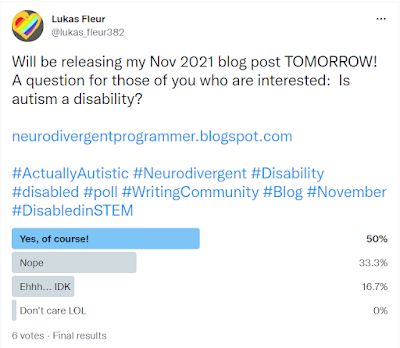
I made a poll on Twitter to see how people on the internet respond to the question "Is autism a disability?" and here are the results below:
Will be releasing my Nov 2021 blog post TOMORROW!  A question for those of you who are interested:  Is autism a disability?, Yes, of course! 50%, Nope 33.3%, Ehhh... IDK 16.7%, Don't care LOL 0%, 6 votes final results


(Please follow me at @lukas_fleur382 to participate in future pollsπŸ˜€ Your opinions may be reflected on a future post!) 

For further information, here are a few videos by autistic YouTubers that express their own opinions on the matter:
It seems that this topic can become quite controversial and heated discussions can arise.  Personally I think this question is rather philosophical because we would have to question what it means to have a disability (or be disabled) and what it means to be autistic.

List of definitions 

Definition of disability (US and UK)

US (Americans with Disabilities Act (ADA)): 

UK (Equality Act 2010): 

"A physical or mental impairment that has a 'substantial' and 'long-term' negative effect on your ability to do normal everyday activities"

  • substantial - e.g. takes much longer than it would usually would to complete a daily task like getting dressed
  • long-term - e.g. 12 months or more 


Definition of autism spectrum disorder

The following are official diagnostic criteria that doctors/psychologists/psychiatrists use internationally when performing an autism spectrum disorder assessment.

Diagnostic and Statistical Manual of Mental Disorders 5th edition (DSM-V)

A. Persistent deficits in social communication and social interaction across multiple contexts, as manifested by the following, currently or by history:

1. Deficits in social-emotional reciprocity, ranging, for example, from abnormal social approach and failure of normal back-and-forth conversation; to reduced sharing of interests, emotions, or affect; to failure to initiate or respond to social interactions.

2. Deficits in nonverbal communicative behaviors used for social interaction, ranging for example, from poorly integrated verbal and nonverbal communication; to abnormalities in eye contact and body languages or deficits in understanding and use of gestures; to a total lack of facial expressions and nonverbal communication.

3. Deficits in developing, maintaining and understanding relationships, ranging for example, from difficulties adjusting behavior to suit various social contexts; to difficulties in sharing imaginative play or in making friends; to absence of interest in peers.

B. Restricted, repetitive patterns of behavior, interests, or activities, as manifested by at least two of the following, currently or by history:

1. Stereotyped or repetitive body movements, use of objects, or speech (e.g. simple motor stereotypes, lining up toys or flipping objects, echolalia, idiosyncratic phrases)

2. Insistence on sameness, inflexible adherence to routines, or ritualized patterns of verbal or nonverbal behavior (e.g. extreme distress at small changes, difficulties with transitions, rigid thinking patterns, greeting rituals, need to take same route or eat same food every day.

3. Highly restricted, fixated interests that are abnormal in intensity or focus (e.g. strong attachment to or preoccupation with unusual objects, excessively circumscribed or perseverative interests).

4. Hyper- or Hyporeactivity to sensory input or unusual interest in sensory aspects of the environment (e.g. apparent indifference to pain/temperature, adverse response to specific sounds or textures, excessive smelling or touching of objects, visual fascination with lights or movement).

C. Symptoms must be present in the early developmental period (but may not become fully manifest until social demands exceed limited capacities, or may be masked by learned strategies in later life).

D. Symptoms cause clinically significant impairment in social, occupational, or other important areas of current functioning.

E. These disturbances are not better explained by intellectual disability (intellectual developmental disorder) or global cognitive delay. Intellectual disability and autism spectrum disorder frequently co-occur; to make comorbid diagnoses of autism spectrum disorder and intellectual disability, social communication should be below  that expected of general developmental level.

Reference:  Centers for Disease Control or Prevention (CDC) 


International Classification of Diseases 11th revision (ICD-11):  Taking into effect starting January 2022

Persistent deficits in the ability to initiate and to sustain reciprocal social interaction and social communication

Range of restrictive, repetitive, and inflexible patterns of behaviour, interests or activities that are clearly atypical or excessive for the individual's age and sociocultural context.

The onset of the disorder occurs during the developmental period, typically in early childhood, but symptoms may not become fully manifest until much later, when social demands exceed limited capacities.

Deficits are sufficiently severe to cause impairment in personal, family, social educational, occupational or other important areas of functioning and are usually a pervasive feature of the individual's functioning observable in all settings, although they may vary according to social, educational, or other context.

Individuals along the spectrum exhibit a full range of intellectual functioning and language abilities.

Reference:   ICD-11 for Mortality and Morbidity Statistics (Version: 05/2021)


What do the definitions all mean?

Disability:

  • Has some kind of medical condition (can be the mind or body)
  • Makes life harder 
    • Finds it hard to get good grades
    • Struggling to get a new job, or sustain a job
    • Finds it difficult to talk/make friends/work with people
    • Finds it difficult to shop or travel on their own
    • Struggles to eat/sleep/go to the toilet/take a bath or shower on their own 
    • etc...
  • Usually long-lasting (months or years)

Autism spectrum disorder

  • Difficulties socializing
    • Understanding what is considered to be "normal"
    • Doing what is considered to be "not normal"
    • Doesn't have friends (or a lot of friends)
    • Friendships don't last long
    • Is not interested in people
    • etc...
  • Is generally considered to be "different"
    • Does the same (or similar) things over and over again
      • Says the same words
      • Lines up toys/tools etc.
      • Paces around and around
      • Hand flapping/pacing/spinning/fidgeting etc. often
    • Likes things the "same" way
      • Same foods
      • Same schedules
      • Same clothes
      • etc.
    • Different expression of interests
      • Likes things that others aren't interested in
      • Likes things a lot more than other people
      • Likes very few things compared to other people
    • Senses differently
      • Finds some lights/sounds/smells etc. a lot more stressful than other people
      • Finds some lights/sounds/smells etc. a lot duller than other people
  • Starts from when they were small kids
    • But might not necessarily struggle until later in life
  • Makes life hard(er)

Is autism a disability?

Arguments FOR autism being a disability

  • IMPAIRMENT in social interaction and communication
  • SUBSTANTIAL LIMITATIONS in life activities
  • Present from early developmental period (long-term)

Arguments AGAINST autism being a disability

  • Symptoms may not become fully manifest until later when social demands exceed limited capacities - Would the person not be autistic at a time when they may not have been "disabled?"
  • Level of functioning may vary depending on the context - If a person struggled greatly in school (e.g. had consistently bad grades), but built a successful career with very few struggles, would the person no longer be considered autistic?  Would they no longer become disabled?
  • Assessing impairment or level of functioning is up to the interpretation of the assessors and the person themselves - lack of consistency

Conclusion

From a purely literal standpoint it may seem obvious that autism is a disability, but the reality is that there is a lot left to interpretation when defining a "substantially significant impairment" for both an autism diagnosis and disability assessment.  It may be safer to assume that autism as a condition is a disability (at least as long as we have the definitions that we have presently) but whether someone identifies as a disabled autistic person is dependent on their situation and the interpretation of the person themselves and the people around them on what it means to be disabled and what it means to be autistic.  

Afterthought

Thank you for reading until the end!  I'm super grateful for my readers that check out my work😍 Please share your thoughts in the comments!  Do you think autism is a disability?  What are some other autism-related topics that you would like me to write about?  If you're interested in my previous autism/neurodiversity related posts, here is a list:
Since next month is December, I'm planning on sharing a story time about learning about a new programming language: R.  Hopefully, it would smoothen the transition to a new era for my blog to talk about a wider variety of topics related to programming.😘

A New Frontier: Building bots without code!!!

 Dear Readers,  Welcome back to this month's Chronicles of a Neurodivergent Programmer.  Last month, I took a break from writing about t...